





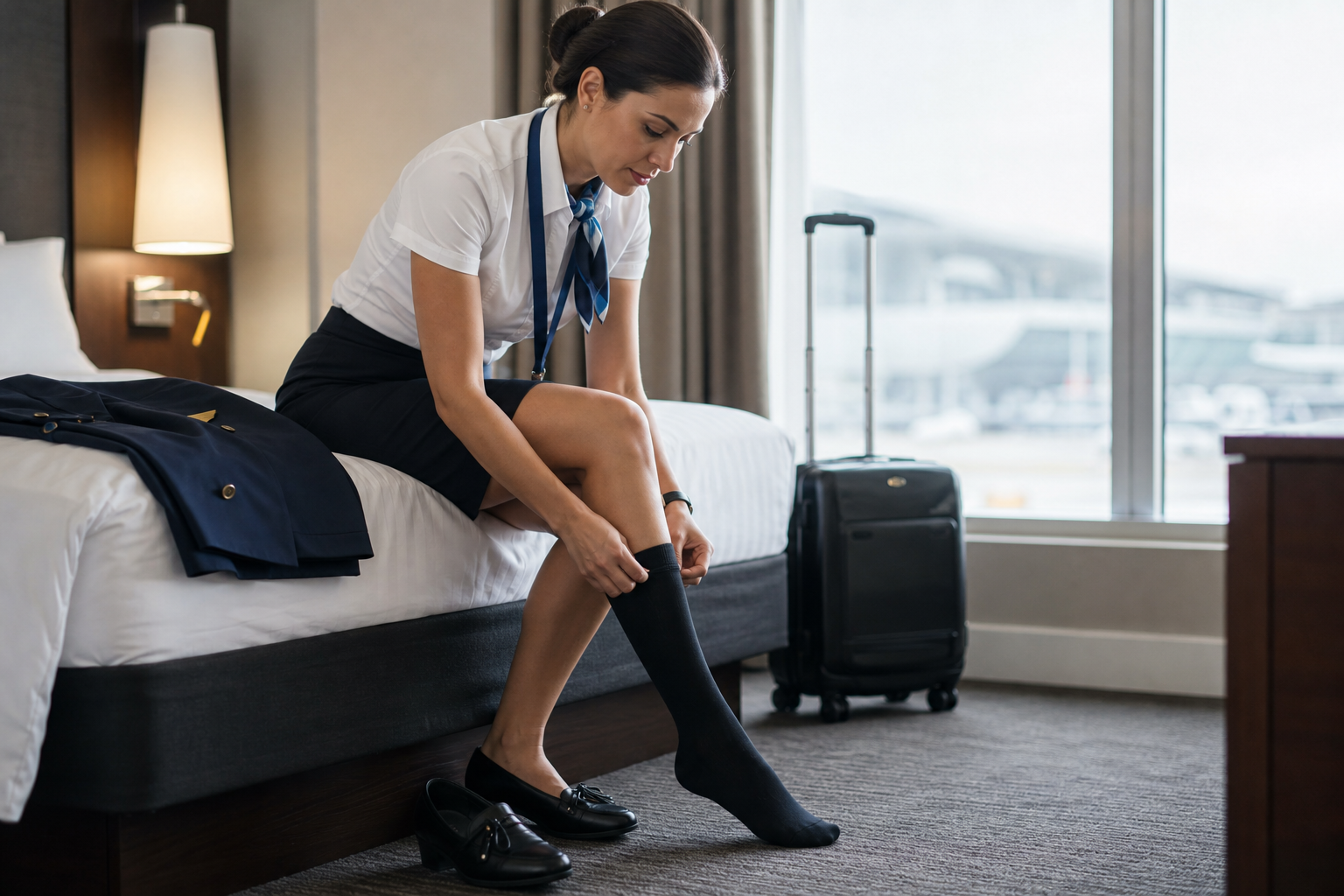
Compression socks can earn a real place in a flight attendant’s routine, but only when they solve the right problem. Long duty days, airport walking, galley standing, cabin pressure changes, and quick turnarounds can all leave your legs feeling heavier than they did at check-in. The best compression socks for flight attendants help support circulation, reduce swelling, and make long workdays feel more manageable without creating extra heat, bulk, or discomfort inside uniform shoes.
That matters because cabin crew do not need generic wellness advice. They need socks that hold up through early report times, long sits on reserve, hotel transfers, deadhead segments, and full days on their feet. If you are already refining your flight attendant essentials or tightening your flight attendant packing list, compression socks can be one of the simplest upgrades for comfort and recovery. That also means thinking about the rest of the kit — a bag that handles crew logistics well and the travel tech that makes downtime more restful both support a complete comfort routine on long days.
If you are putting together a gift guide for a flight attendant in your life, compression socks are one of the most practical additions — the kind of item a working crew member will actually reach for rather than leave unused in a bag.
Why flight attendants use compression socks in the first place
Compression socks are not just for dramatic long-haul days. They can also help on medium-haul schedules, reserve days with lots of waiting and walking, and pairings where you are repeatedly moving between terminals, crew rooms, gates, and hotels. The goal is not perfection. The goal is reducing the heavy-leg feeling that builds over time when you are upright for hours.
- they may help limit ankle and lower-leg swelling after long periods on your feet
- they can make duty shoes feel more comfortable when your legs are already tired
- they support a more consistent routine on back-to-back workdays
- they can be especially useful for crews who commute, work reserve, or regularly operate longer sectors
They are not a replacement for movement, hydration, and sensible rest, but they can be a practical layer inside a crew routine that already includes good shoes, smart packing, and realistic recovery habits.
What level of compression usually makes the most sense
For many flight attendants, mild to moderate compression is the most realistic place to start. Very high compression can feel too restrictive for a long shift if the fit is not right, especially in warmer climates or when your shoes already run snug. A moderate level is often easier to wear consistently, which matters more than buying something aggressive that ends up sitting in your bag unused.
The best approach is usually to choose a pair designed for everyday travel, work, or recovery use rather than something that feels clinical or overbuilt. Crew life rewards repeatable comfort. If you dread putting them on, they are not the right pair for your routine.
Features that actually matter for cabin crew
Flight attendants do not just need compression. They need the right balance of support, breathability, and fit inside work shoes that may already be under pressure by the end of a long day.
- breathable fabric so your legs do not feel trapped on long duty days
- smooth toe seams to avoid rubbing during airport walking
- staying power so the socks do not slide down during the shift
- enough structure at the calf to feel supportive without digging in
- thin-to-medium bulk that still works with your uniform shoes
- easy care because crew routines rarely leave time for high-maintenance laundry habits
If your duty shoes are already borderline tight, even great socks can become annoying. That is why shoe fit matters here too. Compression socks work best when paired with footwear that already supports long standing and walking, which is one reason the right shoes for flight attendants matter as much as the socks themselves.
When compression socks are most useful
Some crew wear them every duty day. Others save them for longer sequences, commutes, or pairings where they know swelling will be more noticeable. Both approaches can be reasonable. The better question is when your body actually benefits from them most.
- multi-sector days with lots of standing and terminal walking
- long-haul or extended sit-stand cycles
- reserve days that turn into long active duty
- commuting days before or after trips
- hotel-to-airport days when your legs still feel tired from the previous pairing
If you are building a practical crew setup, compression socks sit in the same category as chargers, compact organizers, and other travel accessories flight attendants actually use: small items that quietly make the job easier when chosen well.
What to avoid when buying compression socks
- pairs that are so thick they make your duty shoes uncomfortable
- cheap fabric that traps heat and loses shape after a few washes
- socks that look supportive online but slide down in real wear
- overly sporty styling that does not fit your work wardrobe if you need discreet options
- buying only by marketing language instead of checking size guidance and fabric details
It is also worth avoiding the idea that more compression automatically means better performance. The best pair is the one you can wear comfortably through a real crew schedule, not the pair that sounds most intense on a label.
How many pairs should a flight attendant keep?
For most crew, two to four good pairs is a practical range. That gives you enough rotation for back-to-back flying without overbuying before you know what fit and fabric you actually prefer. If you already keep spare grooming, comfort, and recovery items in your luggage system, compression socks are easy to slot into that routine.
What other comfort items should a flight attendant consider for long days?
Beyond compression socks, flight attendants often build their routine around a few complementary items. Supportive duty shoes that hold up through long report days and terminal walks are foundational. A consistent health routine that includes hydration, movement between flights, and proper sleep discipline helps with the leg fatigue that socks alone cannot fully address. Many crew members also find that a good portable charger and noise-cancelling headphones make downtime between sectors more restful.
Final thoughts
The best compression socks for flight attendants are the ones that support long duty days without adding friction to the rest of your routine. Look for breathable fabric, realistic support, shoe-friendly bulk, and a fit you can wear consistently. They will not solve every part of crew fatigue, but they can make a noticeable difference when paired with better shoes, smarter packing, and a more practical comfort system overall.
FAQ
Do flight attendants really wear compression socks?
Many do, especially on long duty days, longer flights, commuting days, or pairings where swelling and leg fatigue are more noticeable.
Are compression socks worth it for short-haul crew too?
They can be. Repeated airport walking, standing in the cabin, and multi-sector days can still create fatigue even when the individual flights are shorter.
Can compression socks be too thick for uniform shoes?
Yes. That is why fabric weight matters. A supportive pair that is too bulky can make otherwise acceptable duty shoes uncomfortable by mid-shift.
What else should flight attendants improve besides socks?
Socks work best as part of a bigger routine that includes better shoes, smarter packing, hydration, and the right set of practical crew essentials.