





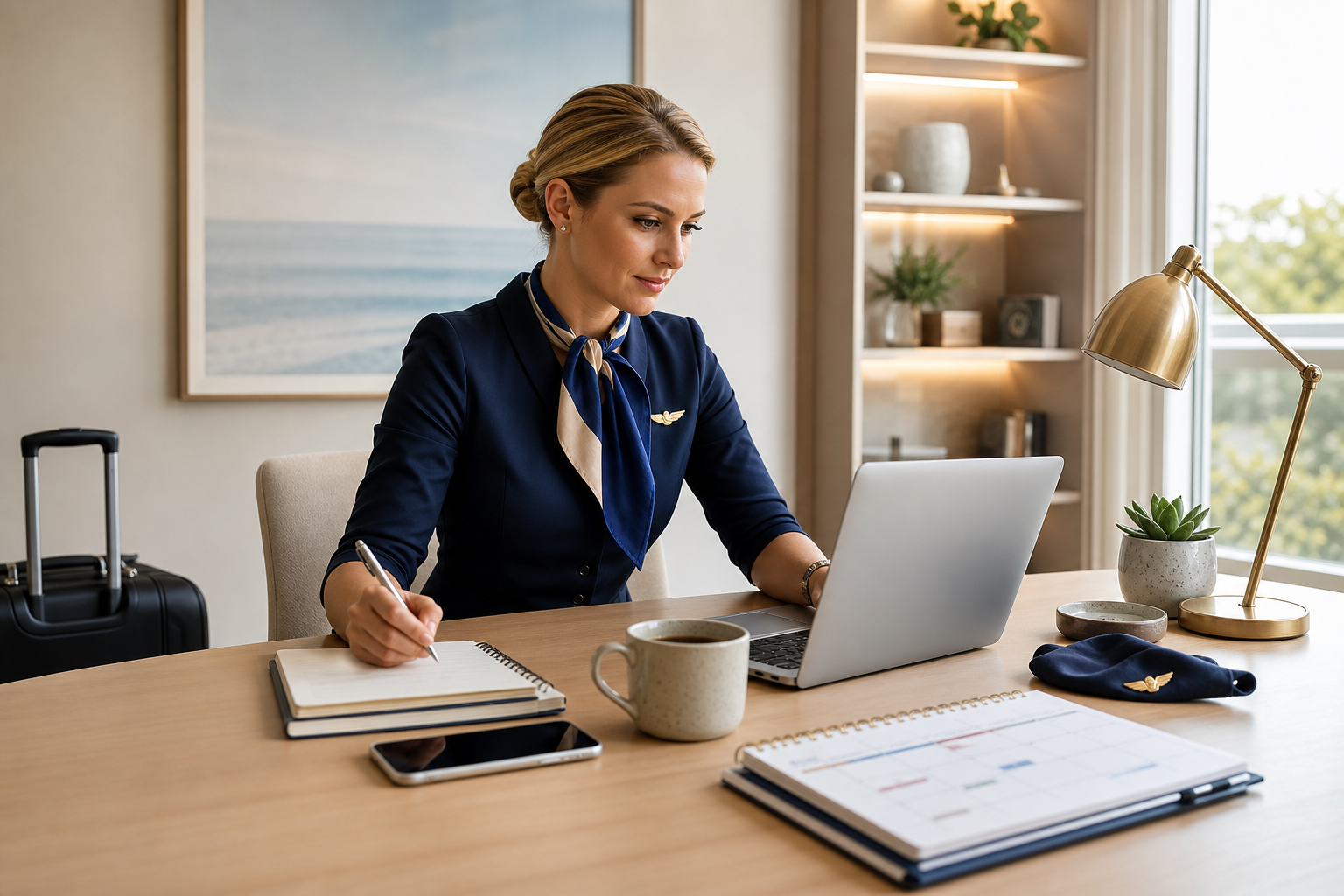
Flight attendant side hustles work best when they fit reserve life, irregular schedules, commuting, and recovery days. The goal is not to stack random gigs on top of an already tiring roster. The goal is to build extra income streams that stay flexible, travel well, and do not put your airline job at risk.
This guide breaks down the most realistic side hustle options for cabin crew, how to choose the right one, what to avoid, and how to build extra income without burning yourself out. If you are still early in the career path, start with how to become a flight attendant and flight attendant interview questions first, then come back to this page once your schedule becomes real.
What makes a side hustle realistic for flight attendants?
The best side hustles for flight attendants usually share five traits:
- flexible hours that can move around reserve, delays, and swap-heavy months
- remote or portable work that does not depend on one city
- low upfront cost so you are not taking big financial risk
- clear boundaries so the work does not affect rest, reporting time, or professionalism
- enough earning potential to matter after taxes, fees, and time spent
If a side hustle only works when your schedule is predictable, it is usually a poor fit for newer crew members. Flexibility matters more than hype.
The most practical flight attendant side hustles
1. Freelance online work
Freelance writing, virtual assistance, basic design support, social media management, proofreading, and customer-support contracts are often the cleanest fit for cabin crew. You can do the work from home base, a crash pad, or a quiet layover if the task does not require a fixed clock-in time.
This category works especially well for flight attendants who already have strong communication, organization, or admin skills. It also scales better than one-off gig work because repeat clients can create steadier income.
2. Tutoring, language help, or coaching
If you are strong in languages, interview prep, study coaching, or aviation-adjacent mentoring, online tutoring can fit well around your schedule. It works best when you open limited time windows instead of promising daily availability.
This is a better fit for crew members who like direct interaction and can maintain consistency without sacrificing sleep after trips.
3. Content creation with a narrow angle
Content creation can work, but only when the angle is specific enough to be useful. Broad “travel lifestyle” content is hard to grow. Narrower angles like commuter routines, crew meal prep, packing systems, interview prep, or new-hire survival tips are usually easier to sustain.
If you go this route, keep compliance in mind. Do not share restricted airline material, do not imply official endorsement, and do not build content around exaggerated crew-life claims.
4. Selling digital products
Digital products can suit flight attendants because the work happens upfront, then sales continue without constant live hours. Examples include printable planners, budget sheets, crew packing checklists, interview prep notes, or simple travel templates.
The upside is flexibility. The downside is that weak products rarely sell just because they exist. This route works best when you already understand a real cabin-crew problem and can solve it clearly.
5. Local service work on home-base days
Pet sitting, house sitting, babysitting, local photography, event support, and other appointment-based work can be useful if you live in one stable base city and know your limits. These side hustles are less portable, but they can still work for line holders with predictable off days.
For reserve-heavy schedules, this is usually riskier than remote work because cancellations and reassignments can create stress quickly.
6. Reselling and small online commerce
Reselling can work if you already understand sourcing, margins, shipping, and returns. It is less attractive when it turns into storage problems, frequent post-office runs, or low-margin busywork. Cabin crew who already enjoy finding undervalued items sometimes do well here, but this is not automatically passive income.
How much can flight attendants realistically earn from a side hustle?
The honest answer is that it depends on your schedule, your skills, and how many hours you can protect each month. But to make this less abstract, here is a realistic monthly earnings range for each of the side hustles above when a flight attendant works them part-time around flying. Treat these as grounded estimates, not guarantees — the top of each range assumes real effort, repeat clients, or an established audience.
| Side hustle | Typical monthly range (part-time) | Schedule fit | Startup cost |
|---|---|---|---|
| Freelance online work | $300–$2,000+ | Excellent (remote, portable) | Low |
| Tutoring / language / coaching | $200–$1,500 | Good (time-window based) | Low |
| Content creation (narrow angle) | $0–$1,500 (slow to start) | Good (async) | Low |
| Selling digital products | $50–$1,200 (builds over time) | Excellent (passive after setup) | Low |
| Local service work (home base) | $200–$1,000 | Fair (needs stable base days) | Low–medium |
| Reselling / small commerce | $100–$1,500 (margin-dependent) | Fair (storage + shipping) | Medium |
Two patterns hold across almost every case. First, remote and digital work scales better than appointment-based work because it survives reserve, swaps, and commuting. Second, the highest earners are rarely doing the most hours — they are doing repeat, skill-based work (retainer freelance clients, a product that keeps selling) rather than one-off gigs. If you are choosing between options, weight flexibility and repeatability over the headline number.
Aviation side hustles: using your crew experience as the edge
Some of the best side hustles for flight attendants are aviation side hustles — income streams that lean directly on your cabin-crew knowledge instead of competing with everyone else online. Interview coaching for aspiring crew, crew-life content, cabin-crew-specific digital products (packing checklists, interview prep notes, commuter guides), and mentoring new hires all let you charge for expertise you already have. These tend to convert better and face less competition than generic freelance work, because the audience trusts someone who has actually flown the line.
How to choose the right side hustle for your schedule
Start with your actual schedule, not your ideal one. A new hire on reserve needs a different plan from a senior crew member holding productive trips and reliable days off.
- If you are on reserve: choose low-pressure, flexible, remote work with no penalty for moving hours around.
- If you are a commuter: avoid side hustles that depend on physical inventory, fixed appointments, or constant local presence.
- If you are a line holder: you can test more structured side income because your off days are easier to protect.
- If you are already stretched: improve your main-job schedule strategy first. In some cases, picking better pairings or adding one extra high-value trip helps more than forcing a second business.
For crew members trying to stabilize work routines overall, it helps to pair this page with flight attendant packing list, flight attendant essentials, and best travel tech for flight attendants so your work setup stays efficient instead of chaotic.
What flight attendants should avoid
- anything that creates fatigue before report time
- side work that conflicts with airline rules, branding, or confidentiality
- high-upfront-cost schemes sold as easy passive income
- business models that depend on daily posting volume you cannot sustain
- income ideas that look profitable only before platform fees, taxes, supplies, and shipping
The fastest way to make a good side hustle bad is to ignore recovery time. A higher monthly total is not a win if you are constantly exhausted, missing deadlines, or hurting performance at your main job.
A simple way to test a side hustle before going all in
Run a small pilot first:
- pick one side hustle, not three
- set a 30-day test window
- define one output goal such as one client, three tutoring sessions, or one small digital product
- track time, stress, and actual earnings
- keep it only if it fits your roster and still feels sustainable after a real month
This approach protects you from building a second job that quietly becomes harder to manage than your first one.
FAQ about flight attendant side hustles
Can flight attendants legally have side hustles?
Usually yes, but airline policy still matters. The side hustle should not conflict with scheduling, fatigue rules, confidentiality, or brand conduct expectations.
What is the best side hustle for new flight attendants?
For most new hires, flexible remote freelance work is the safest starting point because it can move around reserve life more easily than fixed in-person appointments.
How much do flight attendant side hustles pay?
Part-time, most flight attendants realistically earn somewhere between a few hundred and roughly two thousand dollars a month, depending on the hustle and how much time they can protect. Remote, skill-based work such as freelancing or digital products tends to reach the higher end because it scales with repeat clients and ongoing sales rather than hours worked.
What are the best aviation side hustles for cabin crew?
The best aviation side hustles use your crew experience directly: interview coaching for aspiring flight attendants, cabin-crew-focused digital products and checklists, niche crew-life content, and mentoring new hires. They face less competition and convert better because buyers trust guidance from someone who has actually worked the line.
Should you pick up extra trips instead of starting a side hustle?
Sometimes yes. If your airline offers productive pairings and your body can handle them, improving your trip strategy may be simpler than building a separate income stream. But once your schedule stabilizes, a flexible side hustle can diversify your income better than relying only on more flying.
Final thoughts
The best flight attendant side hustles are the ones that survive real crew life. Choose work that fits your schedule, protects your energy, and can still operate during messy months. Extra income matters, but sustainability matters more.